The holidays can be joyful, meaningful—and a lot.
You can look forward to seeing people and still feel tired thinking about the logistics. You can love a tradition and wish it came with fewer expectations. You can be grateful for your life and want ten uninterrupted minutes to yourself.
If your brain already has 50 tabs open, holiday prep does not need to become tab 51.
These holiday stress tips are not a challenge to complete or a new morning routine to master. There are a few small ways to make room for yourself before, during, and after a gathering.
Take what feels useful. Leave the rest.
Holiday stress tips that do not become more homework
Preparing for the holidays does not have to mean anticipating every awkward conversation, managing everyone’s mood, or becoming a perfectly calm version of yourself by Thanksgiving.
It can mean deciding when you want to leave. Permitting yourself to take a break. Leaving a little space after an event instead of scheduling the next thing immediately.
Gratitude, excitement, grief, and frustration can all have a seat at the same table. You do not have to replace the difficult feelings with more festive ones.
A simpler approach: arrive, pause, reset.
💡Quick start: pick just one
Before: choose one permission to give yourself.
During: take a brief pause when you want one.
After: leave a little room to decompress.
You do not need to do all three for any of them to be useful.
Before the gathering: arrive with one intention
Before you walk through the door, try swapping “How do I make this go perfectly?” for a smaller question:
How would I like to show up?
Maybe you want to be present for a conversation instead of mentally organizing the rest of the evening. Maybe you want to enjoy yourself without volunteering for every task. Maybe you simply want to remember that leaving at a reasonable hour is allowed.
Choose one intention—not a personality overhaul.
Give yourself one practical permission
A boundary is easier to use when you know what it looks like. Yours might be:
“I can bring one dish, not coordinate the whole meal.”
“I’m planning to head home at eight.”
“I can change the subject when a conversation becomes uncomfortable.”
“I can enjoy being here without saying yes to everything.”
You do not need a dramatic announcement. A clear, kind sentence is enough.
Try a small arrival pause
If it feels comfortable, take a moment before heading inside. Notice the support beneath your feet. Let your breathing stay easy and unforced for a few breaths.
There is no special count to hit and no need to hold your breath. If paying attention to breathing does not feel helpful, simply look around and notice something ordinary: the porch light, the shape of a tree, the feeling of your coat.
The point is a moment to arrive, not a requirement to feel different before you go in.
During the gathering, make room for a pause
Sometimes the room gets loud. A familiar conversation takes a familiar turn. You realize you have been answering questions, helping in the kitchen, and keeping track of three things at once.
You are allowed to step away before you reach your limit. You also do not have to justify needing a quieter moment.
A pause might look like getting water, finding a less crowded corner, or stepping outside if that is accessible and comfortable.
If you want words to borrow:
“I’m going to take a quick breather. I’ll be back in a few minutes.”
Or, for a conversation you would rather not continue:
“I’d rather leave that topic for another day. How has your week been?”
Give your attention to something simple to land
In a quieter spot, you might notice:
One thing you can see.
One sound you can hear.
The support of the floor or chair beneath you.
There is nothing to finish and no particular feeling to achieve. If an exercise feels uncomfortable, skip it and choose something simpler, like sipping water or looking out a window.
Mindfulness during the holidays does not require being unbothered. Sometimes it is noticing, “I need a minute,” and giving yourself that minute.
A pause will not make everyone agreeable. It can give you a little room to decide what you want to do next.
After the gathering: reset without a performance review
Once you are home, your mind may be ready to replay the evening in high definition.
Was that comment awkward? Did you stay long enough? Should you have helped more? Why did you say that thing near the cheeseboard?
You do not owe the evening a full debrief.
Instead, try asking:
What would feel supportive right now?
The answer might be comfortable clothes, a quiet song, a short walk, or a few minutes without another conversation. It might be leaving the dishes until morning.
If reflection feels useful, keep it gentle:
What is one thing I appreciated?
What would I like to do differently next time?
You can answer either question. You can also answer neither.
A difficult moment does not mean you did the holiday wrong. Needing rest afterward does not cancel out the parts you enjoyed.
Your three-line holiday reset
If having a few words ready would help, copy these into a phone note. This is a place to keep a reminder—not another worksheet waiting to be completed.
Before: I give myself permission to ______.
During: If I want a pause, I can ______.
After: I will leave a little room for ______.
For example: permission to leave when you planned, a pause to get some water, and a little room for a quiet ride home.
Use one line, all three, or none. The point is less pressure.
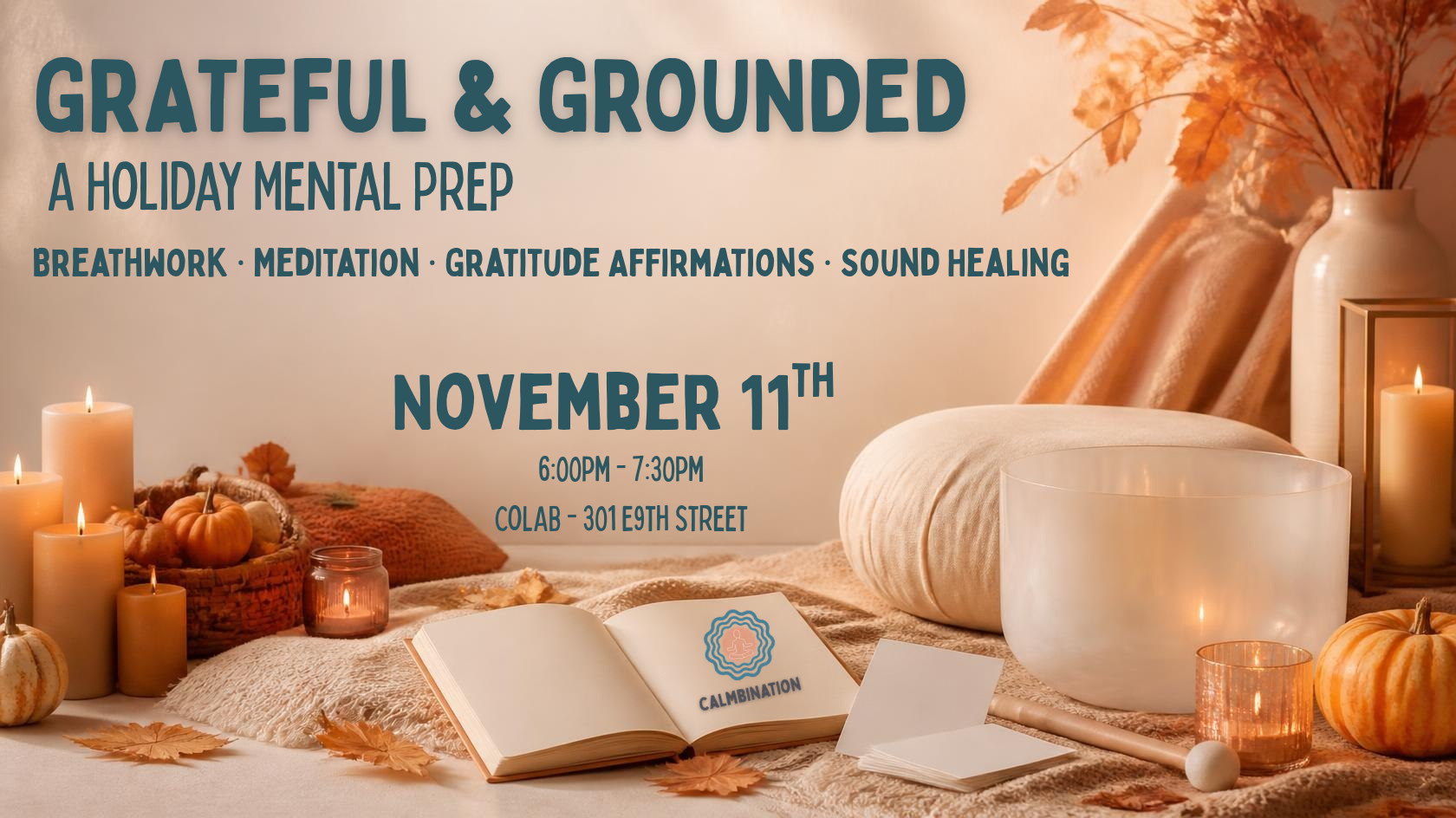
Prefer a guided pause? Join Grateful & Grounded
You do not have to plan and lead every moment of your own holiday preparation. Sometimes it is helpful to have someone guide the practice while you simply take part.
Grateful & Grounded is Calmbination’s holiday reset in Charlotte, bringing together gentle breathwork, guided meditation, gratitude, personal affirmations, and restorative Sound Healing.
Silent Wellness headphones bring the guidance directly to you, creating a more personal listening experience within a shared space.
We will begin with gentle breathwork, move into meditation and reflection, and finish with a restorative Sound Bath. Along the way, you will explore practical calming tools you can return to before a gathering, during a demanding moment, or when you want to step away and reset.
No prior experience is required. Every practice is optional, and you are encouraged to participate at your own pace. There is no pressure to feel grateful, clear your mind, or reach a particular state.
Give yourself room to pause before the holiday pace picks up. Visit the event page for details and sign up for tickets.
Get Grateful & Grounded Tickets
The goal is not a perfect holiday. There is a little more space to find your combination of calm.
A few common questions
How can I prepare for holiday gatherings without adding another routine?
Choose one small thing ahead of time: an intention, a boundary, or a way to take a break. You do not need a daily practice or a detailed plan. Knowing “I can leave when I’m ready” may be more useful than a long checklist.
What can I do if I feel overwhelmed during a holiday gathering?
If possible, step into a quieter setting and give yourself a moment without another demand. You might get water, notice the support beneath your feet, or take a few comfortable breaths. Choose what feels accessible; no single practice works for everyone, and you can skip anything that does not feel helpful.
Do I have to feel grateful to practice gratitude?
No. You can notice something you appreciate without pretending everything feels good. Gratitude does not require you to dismiss grief, frustration, or disappointment. If a gratitude prompt feels forced, leave it for another time.
Do I need meditation or breathwork experience to attend Grateful & Grounded?
No prior experience is required. Guidance is provided, every practice is optional, and you can participate at your own pace. Visit the Grateful & Grounded event page for details and tickets.