If gratitude has started to feel like another thing you’re behind on, you don’t need a longer list.
Maybe it’s Tuesday at 2pm. Your inbox is multiplying, lunch happened somewhere between meetings, and your brain has 50 tabs open. Then comes a reminder to focus on what you’re thankful for.
One more thing to do. Preferably with a better attitude.
Gratitude without the pressure starts somewhere else: you can appreciate parts of your life without pretending the difficult parts are fine.
You can be grateful for your work and need a more sustainable workload. Love the people around you and need some time alone. Appreciate someone’s help and still feel tired.
You can be grateful and still need something to change.
In November, when “be thankful” seems to appear everywhere, that distinction deserves a little space. It matters the rest of the year, too.
Gratitude is not a requirement to feel positive
For this practice, gratitude means noticing something you genuinely appreciate. Not searching for a silver lining on demand. Not comparing your situation with someone who has it worse. And definitely not talking yourself out of a reasonable need.
There’s a difference between these two thoughts:
“At least I have a job. I shouldn’t complain.”
“I appreciate having work that matters to me, and this pace isn’t working.”
The second leaves room for appreciation and honesty. You don’t have to pick one.
There’s no required emotional finish line, either. You might notice something good and still feel frustrated. A thoughtful message from a friend doesn’t erase a difficult afternoon. It can simply be a thoughtful message you’re glad to have received.
That’s enough to begin with.
Try gratitude without the pressure in three minutes
Think of three minutes as an invitation, not a timer you have to beat. You can do this at your desk, by a window, or while your tea cools. If your surroundings feel too busy, move somewhere quieter if that’s practical.
Keep your eyes open if you prefer. Let your breathing stay natural. There’s nothing special to get right.
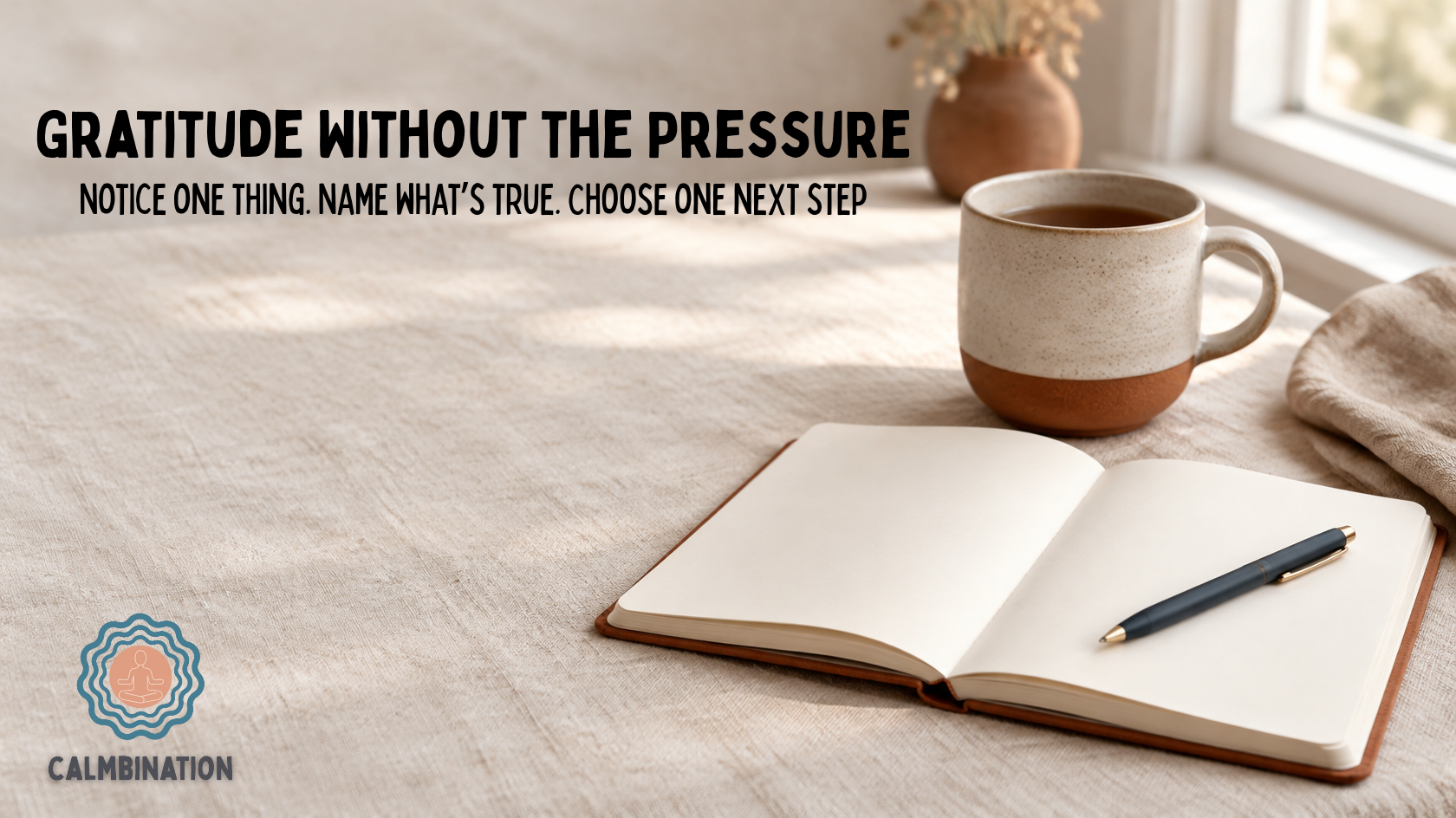
1. Notice one thing
Look for one ordinary thing you genuinely appreciate right now.
It might be the colleague who answered your question without making it complicated. The comfortable chair you’re sitting in. A song you were happy to hear. The fact that you remembered to bring a snack.
Specific is useful here. Instead of reaching for a big statement like “I’m grateful for my friends,” you might think, “I appreciated the friend who checked in without expecting an immediate reply.”
You don’t need three things. Or five. Or anything impressive enough to put in a journal with excellent handwriting.
If appreciation isn’t available today, don’t manufacture it. Notice a neutral detail instead: the weight of your mug, the light on the wall, a sound in the room. You can leave it at noticing.
2. Name what’s true
Next, make room for the rest of your experience.
Ask yourself: What am I feeling, and what do I need?
Your answer might be:
“I appreciated that check-in, and I’m feeling stretched thin.”
“I’m glad this project is moving forward, and I need clearer priorities.”
“This is a quiet moment, and I’m still worried about tomorrow.”
You don’t have to add “but I should be grateful” at the end.
If naming a feeling feels like more work, start with something straightforward: “I’m tired.” “I need lunch.” “I don’t know what I need yet.”
The point isn’t to replace an uncomfortable feeling with a more acceptable one. It’s to notice what’s here without editing yourself into a better mood.
3. Choose one next step
Finally, ask: What’s one small choice available to me?
Not “How do I fix everything?” Just the next manageable thing.
You could refill your water, take a brief pause, ask which deadline comes first, or tell someone when you’ll realistically be able to respond. You might decide to rest before making another decision.
Some problems need more than a small step. A gratitude exercise won’t resolve an unreasonable workload or make a crossed boundary acceptable. Your next step can be acknowledging that a bigger conversation or more support is needed.
And if you don’t want to choose an action right now, you can stop here. This isn’t another productivity technique wearing a softer outfit.
A three-line prompt to keep
Right now, I notice or appreciate: ____.
Also true for me is: ____.
One thing I need, or one small choice available to me, is: ____.
Write it down, think it through, or answer just one line. There’s no streak to protect and no required mood change afterward.
Choose a format that fits your day
If you’d like to return to gratitude occasionally, choose a format that doesn’t ask more of you than you want to give. These are alternatives—not three new habits to maintain.
The one-line journal
Try: “I appreciated ___ because ___.”
“I appreciated having ten uninterrupted minutes because I could finish one thought.”
That can be the whole entry. You don’t need to turn a small moment into a profound lesson.
The occasional gratitude jar
Write down something you’d like to remember and put the note in a jar, a bowl, or a folder on your phone.
Add to it when something stands out. Read it when you feel like revisiting those moments. An empty week is not a missed assignment.
The specific thank-you
Think of something someone did that mattered to you.
“Thank you for explaining that without rushing me” says more than a thank-you you feel obligated to send.
You can share it, say it aloud, or keep the note private. Appreciation doesn’t have to become a public gesture to count.
When appreciation and overwhelm show up together
Imagine a colleague steps in to help with a presentation. You appreciate their support. You’re also exhausted because the deadline changed twice and the rest of your work hasn’t gone anywhere.
Both are true.
Your check-in might sound like this:
“I’m grateful they helped. I’m still overloaded. I need to ask my manager what can move.”
The appreciation doesn’t erase the workload problem. It sits beside it. And the next step addresses what you actually need, rather than asking you to be more positive about being overwhelmed.
That’s the version of gratitude we’re making room for: honest, specific, and small enough to use on an ordinary day.
A quick start for today
If you take one thing from this, let it be these three steps:
Notice one ordinary thing. Appreciation if it’s genuine; a neutral observation if it isn’t.
Tell the truth. Name a feeling, a need, or something that remains difficult.
Choose one manageable next step. Or leave it there.
Save the three-line prompt for a day when it feels useful. Share it with someone who might appreciate permission to keep things simple.
And if you’d like to make space for a guided pause, schedule a conversation with Calmbination about our practical reset experiences.
Find your combination of calm. No gratitude quota required.
A few questions you might have
What if I can’t think of anything I’m grateful for?
You don’t have to force an answer. Try noticing something neutral in your surroundings, or skip the practice altogether. There’s nothing to prove.
Do I need to keep a daily gratitude journal?
No. You can write occasionally, keep a note on your phone, or never write anything down. Choose the format and frequency that fit your life—not the other way around.
Can I feel grateful and frustrated at the same time?
Yes. You can appreciate a person, an opportunity, or a moment while also feeling disappointed, tired, or in need of change. This practice makes room for that combination.
What if I don’t feel better afterward?
A different mood isn’t the assignment. You’re not doing it wrong if your feelings stay the same. You can stop without turning that into something else to judge.