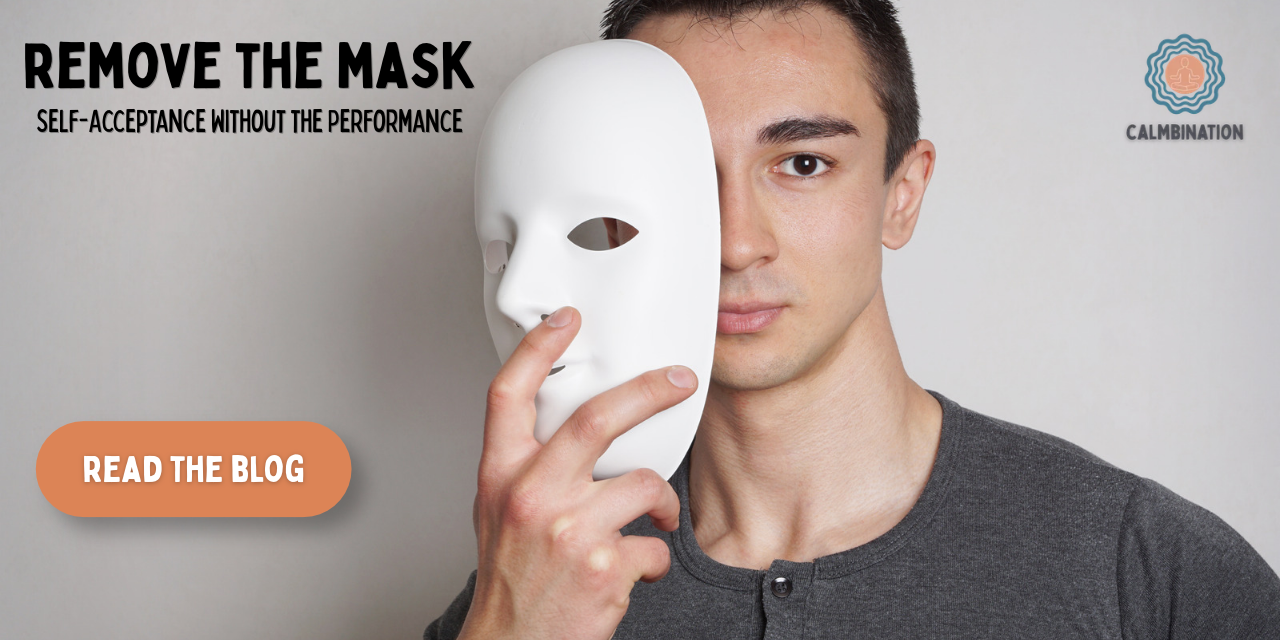
Halloween permits us to become someone else for an evening. A dramatic cape. A mysterious mask. An outfit that absolutely does not work for answering emails.
But some masks stay on long after the costume comes off.
“I’m fine.” “I’ve got it.” “Whatever works for everyone else.”
Self-acceptance starts with making a little room for what those answers might leave out. Not a dramatic reveal. Not a promise to love every part of yourself by Friday. Just a quieter question: What would change if I didn’t have to perform being okay for a moment?
You can explore the answer privately. Nobody needs a front-row seat.
1. Notice the effort of having it all together
Maybe you are the dependable one. The person who remembers the details, sends the follow-up, and somehow knows where the spare charger lives.
Those strengths are real. You do not need to abandon them.
But being capable does not mean you have unlimited capacity. You can be good at your job and need clearer priorities. Love your people and need an evening alone. Handle a difficult week and still wish someone would ask how you are doing.
The useful distinction is not “real you” versus “fake you.” It is the difference between choosing how you show up and feeling as though you are never allowed another option.
Try noticing one moment when “I’m fine” arrives before you have checked whether it is true.
You do not have to correct it out loud. Start with a private sentence:
“What I’m actually noticing is…”
Tired. Disappointed. Proud and overwhelmed. Unsure. More than one thing at once.
You are allowed an answer that would not fit neatly into a status update.
2. Practice self-acceptance without demanding perfection
When people talk about learning how to accept yourself, it can sound like another improvement project. Fix the self-criticism. Develop confidence. Become beautifully unbothered. Preferably before your next meeting.
That is a lot of performance hiding inside an invitation to stop performing.
Try something smaller: What if I did not use this imperfection as evidence against my whole self?
An awkward conversation does not make you incapable of connection. Needing help does not cancel your competence. A mistake is something to address, not a complete description of who you are.
Self-acceptance also does not mean pretending your choices never affect anyone else. You can apologize, learn, or change a habit without deciding you are unworthy until the work is finished.
Compare these two responses:
“I missed something. I always ruin things.”
“I missed something. What needs repair, and what would help me handle it differently?”
The second leaves room for responsibility. It also leaves room for you.
If “I love everything about myself” feels far away, do not force it. Try a sentence that asks less:
“I can be a person in progress and still treat myself with care.”
Self-love does not have to begin as a feeling. It can begin with eating lunch, allowing a pause, or choosing not to turn a difficult moment into a personal insult.
3. Let one small choice be more honest
Living authentically does not require telling everyone everything.
Privacy, boundaries, professionalism, and safety matter. Some settings do not make openness easy or wise. Keeping something to yourself can be an honest choice about what you need.
So instead of asking, “How do I take off every mask?” ask:
“Where do I have room for one choice that feels more like mine?”
That choice might sound like:
“Let me check my capacity before I say yes.”
“I would prefer something quieter tonight.”
“I can finish this tomorrow, not this afternoon.”
“I’m not ready to talk about that.”
It can also remain unspoken: acknowledging that you are tired, noticing a preference, or deciding not to explain yourself in a journal entry nobody else will read.
You do not have to become more visible to become more honest with yourself.
A three-minute self-compassion practice
Think of these as invitations, not steps you have to complete perfectly.
Minute one: Arrive. Notice the support of your chair or the floor beneath your feet. Keep your eyes open if you prefer. Let your breathing stay natural. If focusing inward feels uncomfortable, notice a color or an ordinary sound around you instead.
Minute two: Name what is here. Ask, “What am I working hard to appear to be?” Then, if useful, “What do I actually need?” You can answer with a word. You can also decide that today is not the day for that question.
Minute three: Choose care. Pick one manageable response: a pause before replying, a glass of water, a realistic timeline, or a kinder sentence. You are not trying to solve your whole life in three minutes.
If a warmer feeling does not arrive, you have not failed. Noticing and choosing are enough for this practice.
A reflection to copy and keep
One thing I feel pressure to appear is: ____.
What is also true for me is: ____.
One imperfection I can stop using as evidence against myself is: ____.
One caring or honest choice available to me is: ____.
Something I am allowed to keep private is: ____.
Answer one line or all five. You do not need to share your answers, post a breakthrough, or turn reflection into content.
Keep the costume. Question the pressure.
There is nothing wrong with enjoying a costume—or having different ways of showing up in different parts of your life.
This is simply an invitation to notice when the performance has become tiring, when your inner commentary has become unkind, or when your own preferences keep disappearing from the conversation.
You do not have to remove everything that protects you. You can begin by giving yourself a little more room inside it.
Want a guided place to practice? Check out our podcast episodes HERE.
Prefer a supported experience? Explore a custom Calmbination experience.
Find your combination of calm. You do not have to perform it.
Questions you might have
What is self-acceptance?
Here, self-acceptance means acknowledging your present experience and imperfections without using them to dismiss your worth. You can accept where you are and still want to grow.
How do I accept myself if I do not feel self-love?
Start with a small act of care or a less punishing sentence. You do not have to manufacture affection for yourself to eat, rest, ask for help, or stop calling yourself names.
Does being authentic mean sharing everything?
No. You decide what to share, with whom, and when. Boundaries and privacy can be part of living honestly.
Does self-compassion mean making excuses?
No. You can acknowledge a mistake, make a repair, and plan a different response without treating yourself as beyond care.
What if meditation does not feel helpful?
You can keep your eyes open, focus on your surroundings, shorten the practice, or skip it. This is a wellness resource, not a requirement or a substitute for professional care.