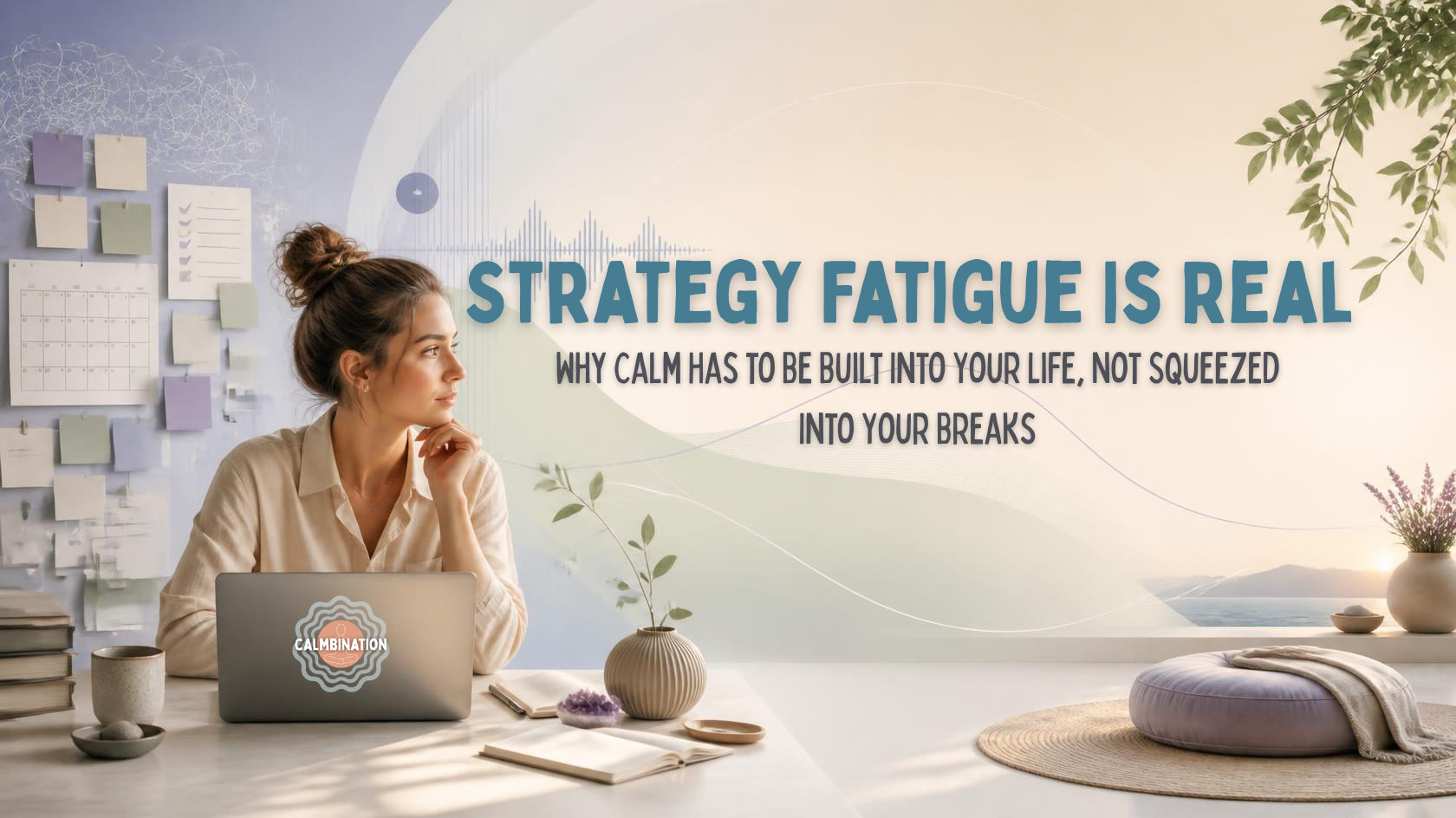
If you have ever opened your planner, looked at your goals, reviewed your habits, checked your notifications, and thought, “I know what to do… so why does everything still feel like too much?” you may be dealing with strategy fatigue.
Strategy fatigue is what happens when your brain and body are overloaded by constant planning, optimizing, decision-making, and self-improvement. It is not laziness. It is not a lack of discipline. It is the nervous system saying, “We cannot keep solving overwhelm with more thinking.”
For high-achieving people, this can be especially sneaky. On the outside, you may look capable, organized, and successful. Inside, you may feel scattered, overstimulated, emotionally flat, or quietly resentful of the systems that were supposed to help you feel better.
The truth is simple: strategy matters, but strategy alone cannot regulate you.
Calm has to be structural.
What is strategy fatigue?
Strategy fatigue is the exhaustion that comes from constantly trying to manage your life through plans, productivity tools, mindset shifts, and problem-solving.
It often shows up when you are doing “all the right things” but still feel disconnected from yourself.
You may have the calendar. The task list. The morning routine. The personal development books. The notes app full of ideas. The saved posts. The habit tracker. The vision board. The perfectly reasonable five-step plan.
And somehow, your body still feels like it is bracing.
That is because strategy lives mostly in the thinking mind. But stress, safety, focus, and capacity live in the body too. If your nervous system is overloaded, another plan can become one more thing to carry.
Signs you may be experiencing strategy fatigue
Strategy fatigue can look different for everyone, but common signs include:
You keep reorganizing your life instead of living it.
You start new systems but struggle to stay with them.
Simple decisions feel unusually heavy.
You feel guilty for resting, even when you are exhausted.
You crave structure but also feel trapped by it.
You consume a lot of advice but rarely feel settled.
Your mind feels busy, but your body feels tired.
You mistake calm for falling behind.
You feel like you need a reset, but you do not know where to begin.
This is not a character flaw. It is a capacity signal.
Your system is asking for less pressure and more support.
Why quick hacks are not enough
There is nothing wrong with a helpful tip. A breathing exercise, a productivity method, or a mindset reframe can be useful.
But when stress has become the operating system, quick hacks often become temporary relief rather than real change.
A hack says, “Here is something to try when you are already overwhelmed.”
A structure says, “Here is how we make overwhelm less likely to run the show.”
That difference matters.
When calm is treated as a bonus activity, it becomes the first thing to disappear when life gets full. But when calm is built into your environment, schedule, relationships, routines, and recovery practices, it becomes easier to access before burnout takes over.
Regulation is not about forcing yourself to be peaceful all the time. It is about creating conditions where your body can return to steadiness more often.
Calm is structural
Structural calm means your life is designed to support your nervous system, not constantly test it.
It can include:
Clearer boundaries around your time and energy
Fewer unnecessary decisions
Repeatable rituals that help your body settle
Spaces that reduce sensory and mental clutter
Breath, meditation, sound, and movement practices
Recovery time that is protected, not optional
Systems that support your real capacity, not your fantasy capacity
This is where calm becomes practical. It is not just a feeling you chase. It is a framework you build.
At Calmbination, we often think of this through a simple rhythm: Recognize, Rewire, Reset.
First, recognize what is happening in your mind, body, and environment. Then, rewire the patterns that keep pulling you into stress. Finally, reset with practices and structures that help you come back to yourself.
3 practical resets for strategy fatigue
If you are feeling the weight of strategy fatigue, you do not need to overhaul your entire life today. Start with one small reset.
1. Breath: shift from solving to settling
When the mind is overloaded, breath can give the body a direct signal of support.
Try this:
Sit comfortably and place one hand on your chest or belly.
Inhale through your nose for a count of four.
Exhale slowly for a count of six.
Repeat for three to five rounds.
Ask yourself: “What actually needs my attention next?”
Longer exhales can help invite the body toward a calmer state. The goal is not to erase your thoughts. The goal is to give your system enough steadiness to choose your next step instead of reacting from pressure.
2. Sound: interrupt the mental loop
Sound can be a powerful reset because it gives the mind something gentle to follow.
You can use calming music, a sound bath recording, humming, a singing bowl, nature sounds, or even a quiet room with one steady tone.
Try this:
Choose one sound that feels soothing.
Close your eyes or soften your gaze.
Let your attention rest on the sound for two minutes.
When your mind wanders, return to listening.
Notice what feels different in your body afterward.
Sound helps create a bridge from thinking into sensing. For people who struggle to “just relax,” sound can offer a focal point that feels less forced than silence.
3. Structure: remove one unnecessary decision
Sometimes the most calming thing you can do is make life simpler.
Strategy fatigue grows when every moment requires a fresh decision. Structural calm reduces unnecessary choices so your energy can go toward what actually matters.
Try this:
Pick one repeatable moment in your week that currently feels chaotic.
Choose a simple default.
Write it down somewhere visible.
Examples:
Monday mornings are for planning, not reacting.
Wednesday lunch is always a reset walk.
Sunday evening is for reviewing the week and choosing three priorities.
After work, the first 10 minutes are screen-free.
When overwhelmed, the next step is always: breathe, drink water, write one sentence.
A good structure should feel supportive, not punishing. If it requires a version of you that only exists on perfect days, simplify it.
Your next step: build your personal calm blueprint
If strategy fatigue has been running the show, you do not need more pressure. You need a calmer structure that actually fits your life.
A Calm Reset is a focused starting point for recognizing what is draining your capacity and choosing practical ways to reset your rhythm. A Personal Calm Blueprint goes deeper by helping you design repeatable supports across your schedule, space, habits, and recovery practices.
The goal is not to become a perfectly optimized person.
The goal is to feel more like yourself in the life you are already building.
If you are ready to stop treating calm like a luxury and start building it into your life, book a Calm Reset or explore your Personal Calm Blueprint.
Your nervous system does not need another productivity challenge.
It needs a structure that lets you breathe.